India Province: the Beginning of the Beginnings
India is known for its religiosity and missionary activity. During the 1960’s, after Vatican II, Europe experienced a decline in vocations while Asian countries like Indi, were flourishing. At this point in time Fr. Joseph Kundukulam from Kerala (southern part of India), happened to visit Germany at the MSC Motherhouse and witness the decline in vocations in Europe. Once he went back to Kerala, he discussed this matter with his co-priests and formed a group. They invited the young girls from the parishes of his diocese and prepared them to join any of the congregations. After a short period of training by these priests, eight young girls came forward to join the Missionary Sisters of the Most Sacred Heart of Jesus. They were received by our MSC Sisters at Hiltrup in 1966 with an open heart and were sure that they were in the right place under the care of the Sacred Heart of Jesus Himself. They did their initial formation to religious life, professed their first vows in 1970, received professional training as nurses and teachers, and were happy and contented.
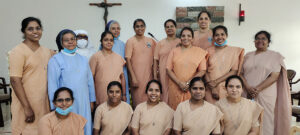
Soon afterward, Bishop Joseph Kundukulam requested that the sisters be returned to India and become missionaries among their own people, thus extending the congregation to India. It was indeed very pleasant news for them and the congregation to spread the motto of the MSCs, “May the Sacred Heart of Jesus be Loved Everywhere.” While some of the young sisters left the congregation, Ss. Sandra, Viola, Alis and Bernarda came back to India in January 1976 after joyfully having pronounced their final vows.
The sisters faced a few challenges during this time. First, they were asked to update their professional studies to work in India because they had German certificates which were not recognized in India. For this, they had to go to different cities and hospitals. Second, they had to start promoting vocations for this new branch of the MSC family. Girls responded quickly to them and soon the pioneers spread the charism and mission of the congregation in a small and wider manner.
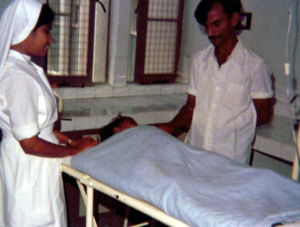
In 1977 the sisters formed the first Indian community in a rented house in Koramangala, Bangalore where they engaged in the healing and teaching ministries and studied the situation of the place. One year later they bought their first house in Viveknagar, Bangalore and named it Sneha Bahavan, House of Love. It was large enough to start a kindergarten, clinic, social work center for mother/child programs and a sewing school. On January 21, 1979, Sr. Alis was appointed as superior, and the Indian Community officially began.
Any growth requires struggles, so like cocoons turning into beautiful butterflies, the newly found mission also had to go through its own transformation. Even though they had left Germany, the kind sisters of the German province never left the sisters in Indian orphans. They rendered their help financially and personally. They sent two sisters from Australia to India to help the sisters construct the convent and to take care of other matters. In 1977 they sent Sr. Astrid and Sr. Jacintha. Sr. Astrid went around educating the local people about family planning and Sr. Jacintha took care of the construction of the convent. Sr. Astrid went back to Australia after one year and Sr. Jacintha stayed behind. Unfortunately, Sr. Jacintha unexpectedly went to her heavenly award on July 12, 1979.
Sr. Jacintha’s death was shocking for the sisters for they had invested all their trust and hope in her to continue the mission. Her death created a vacuum for these young sisters, so German born Sr. Gottfrieda stayed in India and continued the missionary activity in Bangalore.

The sisters many other struggles included learning the different languages and living among the poorest of the poor. India is a multi-ethnic and multilingual country which consists of 28 states and eight union territories. All the states, especially the southern states of India, speak different languages. With the help of the local people, the sisters soon overcame the language barrier.
Another struggle was to try to understand the local people who would often try to trespass on the property out of curiosity. This place was one of the slums and was a home for wild roses and for plenty of reptiles. Life in this place was not a bed of roses for them.
The dream of the MSC founder, however, flourished on Indian soil. As Jesus commanded, “Go to the ends of the world and proclaim my name to all nations,” the MSC’s presence in India has spread into six states and is very much appreciated today wherever MSC Sisters serve: through day care centers for children, hostels for students and working women, a school, a senior citizens’ home, schools, hospitals, parishes, and social work. MSC Sisters are certain that Fr. Linckens is happy to see us growing in number and in the mission of his vision!

FOR PERSONAL REFLECTION
- What values of the MSC charism and what vision of the Church Mission today will sustain them into the future?
- Which of these values will you need to preserve, let go and claim as new? (Identify 2-3)